Friday, April 20, 2007

Gone Tomorrow: The Hidden Life of Garbage


Gone Tomorrow: The Hidden Life of Garbage

by Heather Rogers

Paperback:
304 pages
Publisher:
New Press (September 1, 2006)

Americans produce the most waste of any people on Earth, says Rogers, but few of us ever think about where all that trash goes. Rogers endeavors to show the inner workings of the waste stream, from the garbage truck to the landfill, incinerator or parts unknown. She points out that recycling, once touted as an environmental lifesaver, "has serious flaws," and has done little to mitigate garbage's long history of environmental damage. Rogers also includes chapters on the history of waste removal and disposal, highlighting early sanitation efforts in New York City, as well as the multi-billion-dollar, multinational business of garbage. Consistently engaging, the book delineates the myriad problems caused by the country's waste output, but offers very few concrete examples of what readers can do to improve the garbage situation; instead, Rogers stoically acknowledges that "while consumers making choices with the environment in mind is a good thing, it is in no way a real solution to our trash woes." Nevertheless, the book is an intriguing look into an often misunderstood and overlooked industry. She argues convincingly that our consumerist economy is literally built on trash. If you think global warming and altered ocean chemistry are legitimate threats to our childrens' futures, then you should add this book to your must-read list.

Order at Amazon.com

Sunday, April 15, 2007

Gaia's Kitchen

Gaia's Kitchen: Vegetarian Recipes for Family & Community

by Julia Ponsonby (Author)

Paperback:
216 pages
Publisher:
Chelsea Green Publishing Company (March 2001)

Based on the menu from Schumacher College in Devon, England, this book of recipes (and more) is by far the best vegetarian cookbook I have ever come across. The whole philosophy extends to conservation, preservation, sustainability, biodiversity - and is a lesson to us all.
Winner of the 2001 Best Vegetarian Cookbook award, this is much more than just a collection of recipes. Subscribing to scientist Lovelock's view of the Earth as a biodynamic whole, Gaia's Kitchen stresses developing an understanding of our relationship to what grows around us, and the importance of cooking as a part of our daily lives.

Order at Amazon.com

Gaia: A New Look at Life on Earth

Gaia: A New Look at Life on Earth

by James Lovelock (Author)

Paperback:
176 pages
Publisher:
Oxford University Press, USA; New Ed edition (September 25, 2000)


James Lovelock's book "Gaia: A New Look at Life on Earth" reads like a libertarian manifesto. In this classic work that continues to inspire its many readers, Lovelock puts forward his idea that life on earth functions as a single organism. Written for non-scientists, Gaia is a journey through time and space in search of evidence with which to support a new and radically different model of our planet. In contrast to conventional belief that living matter is passive in the face of threats to its existence, the book explores the hypothesis that the earth's living matter air, ocean, and land surfaces forms a complex system that has the capacity to keep the Earth a fit place for life. Since Gaia was first published, many of James Lovelock's predictions have come true and his theory has become a hotly argued topic in scientific circles. In a new Preface to this reissued title, he outlines his present state of the debate.

The 3 major principles he brings to light about Gaia are:

1. Gaia exhibits a tendency to keep conditions (e.g., temperature, air quality) constant for all terrestrial life.

2. Like other living systems, Gaia has vital organs at the core, and expandable or redundant ones on the periphery.

3. Under the worse conditions, Gaia responses similar to other cybernetic systems (i.e., where time constant and loop gain are important)

The material is far reaching in both its scope and in shaping our understanding of where we stand. Put in the context of Gaia, we have straddled ourselves to the largest of all known living and breathing creatures.
If you buy this book, use it as a point of departure--into biology, ecology, or ecopsychology, perhaps. Or into that state of humility that pauses to wonder what the world is thinking and feeling.

Order at Amazon.com

Saturday, April 14, 2007

The Economics of Climate Change: The Stern Review


The Economics of Climate Change: The Stern Review

by Nicholas Stern (Author)

Paperback:
712 pages
Publisher:
Cambridge University Press (January 15, 2007)

There is now clear scientific evidence that emissions from economic activity, particularly the burning of fossil fuels for energy, are causing changes to the Earth's climate. A sound understanding of the economics of climate change is needed in order to underpin an effective global response to this challenge. The Stern Review is an independent, rigourous and comprehensive analysis of the economic aspects of this crucial issue. It has been conducted by Sir Nicholas Stern, Head of the UK Government Economic Service, and a former Chief Economist of the World Bank. The Economics of Climate Change will be invaluable for all students of the economics and policy implications of climate change, and economists, scientists and policy makers involved in all aspects of climate change.
"The Stern Review of the Economics of Climate Change provides the most thorough and rigorous analysis to date of the costs and risks of climate change, and the costs and risks of reducing emissions. It makes clear that the question is not whether we can afford to act, but whether we can afford not to act. To be sure, there are uncertainties, but what it makes clear is that the downside uncertainties—aggravated by the complex dynamics of long delays, complex interactions, and strong non-linearities—make a compelling case for action. And it provides a comprehensive agenda—one which is economically and politically feasible—behind which the entire world can unite in addressing this most important threat to our future well being."
Joseph Stiglitz, Nobel Prize economist 2001

Order at Amazon.com

Here is a summary of the report:
The first half of the review focuses on the impacts and risks arising from uncontrolled climate change and on the costs and opportunities associated with action to tackle it. A sound understanding of the economics of risk is critical here. The review emphasizes that economic models over timescales of centuries do not offer precise forecasts—but they are an important way to illustrate the scale of effects we might see.

The review finds that all countries will be affected by climate change, but it is the poorest countries that will suffer earliest and most. Unabated climate change risks raising average temperatures by over 5°C from pre-industrial levels. Such changes would transform the physical geography of our planet, as well as the human geography—how and where we live our lives. Adding up the costs of a narrow range of the effects, based on the assessment of the science carried out by the Intergovernmental Panel on Climate Change in 2001, the Review calculates that the dangers of unabated climate change would be equivalent to at least 5 percent of GDP each year.

The review goes on to consider more recent scientific evidence (for example, of the risks that greenhouse gases will be released naturally as the permafrost melts), the economic effects on human life and the environment, and approaches to modeling that ensure the impacts that affect poor people are weighted appropriately. Taking these together, the review estimates that the dangers could be equivalent to 20 percent of GDP or more.

In contrast, the costs of action to reduce greenhouse gas emissions to avoid the worst impacts of climate change can be limited to around 1 percent of global GDP each year. People would pay a little more for carbon-intensive goods, but our economies could continue to grow strongly.

If we take no action to control emissions, each ton of CO2 that we emit now is causing damage worth at least $85—but these costs are not included when investors and consumers make decisions about how to spend their money. Emerging schemes that allow people to trade reductions in CO2 have demonstrated that there are many opportunities to cut emissions for less than $25 a ton. In other words, reducing emissions will make us better off. According to one measure, the benefits over time of actions to shift the world onto a low-carbon path could be in the order of $2.5 trillion each year.

The shift to a low-carbon economy will also bring huge opportunities. Markets for low-carbon technologies will be worth at least $500 billion, and perhaps much more, by 2050 if the world acts on the scale required.

Tackling climate change is the pro-growth strategy; ignoring it will ultimately undermine economic growth.

The review looks at what this analysis means for the level of ambition of global action. It concludes that the levels of greenhouse gases in the atmosphere should be limited to somewhere within the range 450-550ppm CO2e (CO2 equivalent). Anything higher would substantially increase risks of very harmful impacts but would only reduce the expected costs of mitigation by comparatively little. Anything lower would impose very high adjustment costs in the near term and might not even be feasible, not least because of past delays in taking strong action.

The second half of the review examines the national and international policy challenges of moving to a low-carbon global economy.

Climate change is the greatest market failure the world has seen. Three elements of policy are required for an effective response.

The first is carbon pricing, through taxation, emissions trading or regulation, so that people are faced with the full social costs of their actions. The aim should be to build a common global carbon price across countries and sectors.

The second is technology policy, to drive the development and deployment at scale of a range of low-carbon and high-efficiency products. And the third is action to remove barriers to energy efficiency, and to inform, educate and persuade individuals about what they can do to respond to climate change.
Fostering a shared understanding of the nature of climate change, and its consequences, is critical in shaping behavior, as well as in underpinning both national and international action.

Effective action requires a global policy response, guided by a common international understanding of the long-term goals for climate policy and strong frameworks for co-operation. Key elements of future international frameworks should include:

Emissions trading
• Expanding and linking the growing number of emissions trading schemes around the world is a powerful way to promote cost-effective reductions in emissions and to bring forward action in developing countries. Strong targets in rich countries could drive flows amounting to tens of billions of dollars each year to support the transition to low-carbon development paths.

Technology cooperation
• Informal coordination as well as formal agreements can boost the effectiveness of investments in innovation around the world.
• Globally, support for energy research and development should at least double, and support for the deployment of low-carbon technologies should increase up to five-fold.
• International cooperation on product standards is a powerful way to boost energy efficiency.

Action to reduce deforestation
• The loss of natural forests around the world contributes more to global emissions each year than the transport sector. Curbing deforestation is a highly cost-effective way to reduce emissions; large-scale international pilot programs to explore the best ways to do this should get underway very quickly.

Adaptation
• The poorest countries are most vulnerable to climate change. It is essential that climate change be fully integrated into development policy, and that rich countries honor their pledges to increase support through overseas development assistance.
• International funding should also support improved regional information on climate change impacts, and research into new crop varieties that will be more resilient to drought and flood.

Order at Amazon.com
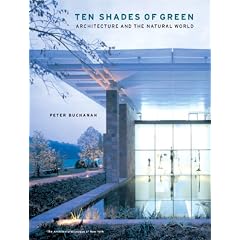
Ten Shades of Green: Architecture and the Natural World


Ten Shades of Green: Architecture and the Natural World

by Peter Buchanan (Author), Kenneth Frampton (Foreword)

Paperback: 128 pages
Publisher:
W. W. Norton (December 19, 2005)

This book centers on ten buildings which illustrate how environmental responsibility influences modern architectural pursuits.
Buchanan also lays out ten elements that are important in green design, although he does not look for all of the projects to address all of these criteria. Some only address a few of the ten points, while some others incorporate more than half of them. The ten facets of green architecture which Buchanan identifies include:
  • Low Energy/High Performance
  • Replenishable Sources
  • Recycling: Eliminating Waste and Pollution
  • Embodied Energy
  • Long Life, Loose Fit
  • Total Life Cycle Costing
  • Embedded in Place
  • Access and Urban Context
  • Health and Happiness
  • Community and Connection
Peter Buchanan is a curator and critic: his choices reflect designs which blend environmental responsibility with design excellence, showing how such a focus provides architects with new, innovative ideas.

Order at Amazon.com

Wednesday, April 11, 2007

The Revenge of Gaia


The Revenge of Gaia: Earth's Climate Crisis and the Fate of Humanity

by James Lovelock (Author)

Hardcover:
176 pages
Publisher:
Basic Books (July 3, 2006)

British geophysicist James Lovelock introduced the Gaia theory in the early 1970s, envisioning the biosphere as "an active, adaptive control system able to maintain the earth in homeostasis." Since then, Lovelock has expanded the Gaia concept to embrace "physical, chemical, biological, and human components," recognizing that organisms do change the environment, none more radically than humanity. Lovelock now describes Gaia as fighting for its very existence as a rapidly increasing human population threatens to upset the precise balance of forces the make the earth conducive to life. Lovelock looks beyond biodiversity to elucidate the functions of the polar ice caps, Amazon rain forests, and ocean currents, and then explains the causes and consequences of global warming. This is solid science, a practice Lovelock seems to abandon in his strangely irresponsible arguments for nuclear energy and against sustainable energy sources. In spite of its flaws, Lovelock's tough-minded presentation is a valuable contribution to the urgent debate over humankind's future.
Lovelock diagnoses the Earth as suffering from a fever. Its atmospheric and oceanic temperatures are rising. The infecting agent is a complex organism that has emerged only recently in Earth's history, although it spread rapidly. It's Homo sapiens - ourselves. Humans have usurped woods and prairies, cutting down forests and turning rangeland into farms for our sustainance. Although we declare these transformations are necessary to our survival, the changes have fatally disrupted the Earth's fine balance among land, sea and air. To Lovelock, that balance is a natural system. He's named the system "Gaia" from ancient Greek mythology. Although the "Gaia" concept has its critics, from doubtful to severe, Lovelock has convinced most scientists that the interaction of many elements must be viewed as tightly integrated. What affects one part will surely influence another - or many. And the effect is incalcuable. In this case the effect appears to be terminal. Which means if "Gaia" dies, the living things on this world will go with it. That means us. Gaia's revenge will be to exterminate her affliction.
It's common knowledge that our planet's in trouble. The number of books and articles testifying to this condition are almost beyond counting. Lovelock himself acknowledges that there will be dismay at the appearance of "another book on global warming". Lovelock's approach, however, is a departure from the other offerings on this topic. Having postulated the Earth as an organic whole, he can address the problem as a physician. There will be diagnosis and analysis of symptoms. There will also be some suggested therapy. Like many medicines, his prescriptions will be unpalatable to many.
Order at Amazon. com

Monday, April 9, 2007

WorldChanging: a user's guide for the 21st century

Worldchanging: A User's Guide for the 21st Century

by Alex Steffen (Author), Al Gore (Foreword), Bruce Sterling (Introduction)

Hardcover: 608 pages
Publisher:
"Harry N. Abrams, Inc." (November 1, 2006)

This 600-page companion to the eco-friendly website of the same name (www.worldchanging.com) is chock-a-block with information about what is going on right now to create an environmentally and economically sustainable future-and what stands in opposition.
If Gore's film "An Inconvenient Truth" (also here is a book) moved you, then Steffen's "Worldchanging: A User's Guide for the 21st Century" will move you to action.
This is a beautifully crafted book that should be cherished - so full of resourceful ideas from around the world on how to live a more eco-friendly, sustainable life - without having to turn your back on the comforts of the 21st century. It's the ultimate feel-good book that lets you know there's hope for the planet if you're willing to make changes here and there in your daily life that really aren't all that inconvenient. Don't worry - the book doesn't lecture. It just INSPIRES.
For those concerned with our planet and future, reading this book, and acting upon what you read, is as important as, and equal to, voting. As this book shows, each changed person, even a changed habit, can add up towards making a huge and crucial difference in our environment and future - towards a Changed World.
This book is full of information, facts most people never knew but need to learn. It covers so many topics from all over the world, it would interest anyone regardless of political affiliation or environmental commitment.

Order at Amazon.com